What Sustainable Development Actually Means, and What the Definition Left Out
Sustainable development has been defined the same way since 1987, by a single sentence in a United Nations report. Drawing on the Brundtland Report and four decades of work that followed it, this paper decodes what that definition actually says, what it deliberately left open, and why the opening is still being argued over in Indian district offices today.
Sustainable development has a formal definition, and it has had the same one for very nearly forty years. Open any corporate sustainability report, any state policy preamble, any conference brochure (including, in all honesty, some of ours) and you will find the same sentence, or a paraphrase of it, doing the work.
Development that meets the needs of the present without compromising the ability of future generations to meet their own needs.
It is among the most quoted sentences of the last half century. It comes from Our Common Future, the 1987 report of the World Commission on Environment and Development, chaired by Gro Harlem Brundtland, then Prime Minister of Norway. The report is usually called the Brundtland Report, and it set the terms for the 1992 Rio Earth Summit and for most of what followed.
It is also quoted far more often than it is read, and the gap between the sentence and the report matters, because almost every difficulty the field has had since 1987 was visible in that gap from the beginning.
One Sentence, Three Claims
Read it slowly and the definition turns out to be carrying three separate claims at once.
The first is a claim about time. It asserts an obligation to people who do not yet exist, and who cannot participate in the decision. That is a moral position, not a technical one, and it is doing more work than its plainness suggests.
The second is a claim about scarcity. ‘Without compromising the ability’ only means something if some capacity can in fact be used up. The sentence assumes limits without naming any.
The third is a claim about needs, as distinct from wants. The word chosen is not consumption, not growth, not standard of living. It is needs, which sets a floor, and implies that meeting that floor is the legitimate business of development.
Three claims, one sentence, and no numbers anywhere in it. That was not an oversight.
The Choices Behind the Definition
The report’s most consequential moves were refusals, and they are the part that never makes it into the quotation.
It refused to set environment against development. In 1987 the conventional framing was a trade-off: a country could have forests or factories. Brundtland rejected that structure and argued that environmental degradation and poverty are entangled: that poverty drives degradation, and degradation deepens poverty. For a commission reporting to a world sharply divided between industrialised and developing countries, this was the political core of the document, and it is why the report was acceptable in Delhi as well as in Oslo.
It refused to be a technical document. There are no thresholds in the definition, no tonnes, no parts per million, no dates. What it produced was a principle, and a principle is what you write when the science is not settled enough to write a limit, or when naming a limit would cost you the signatures.
A definition that specifies nothing can be agreed by everyone. That is its strength, and it is also the entire subsequent problem.
The Undefined Middle: Whose Needs, How Far, How Much
What the sentence leaves open, it leaves open completely. Call it the undefined middle, and note that every serious argument in sustainability policy since 1987 has taken place inside it.
Whose needs? The definition says ‘the present’ as though the present were a single constituency. It is not. The needs of a farmer in Bundelkhand and the needs of a data centre in Gurugram are both present needs, and they compete for the same aquifer.
How far ahead? Future generations is unbounded. A twenty-year horizon and a two-hundred-year horizon produce completely different investment decisions, and the sentence does not choose.
How much is compromising? This is the load-bearing question, and the one that took the field thirty-six years to begin answering.
Putting Numbers to the Principle
The honest answer is that it was never meant to be, and that most of the intellectual history of this field since has been an attempt to put numbers into the middle of Brundtland’s sentence. Three attempts matter.
- Planetary boundaries, 2009. Johan Rockström and colleagues proposed that nine Earth system processes have thresholds beyond which the stable conditions of the Holocene cannot be relied upon. For the first time, ‘compromising’ had candidate values attached to it.
- The Doughnut, 2017. Kate Raworth added a floor beneath the ceiling. Her social foundation has twelve dimensions drawn from the Sustainable Development Goals: food, health, education, income and work, peace and justice, political voice, social equity, gender equality, housing, networks, energy and water. Between the floor and the ceiling lies what she calls “an ecologically safe and socially just space in which all of humanity has the chance to thrive.” At the time she wrote, at least four of the nine boundaries were in overshoot.
- Safe and just Earth system boundaries, 2023. The Earth Commission quantified boundaries on two criteria at once: safe, meaning the Earth system stays stable, and just, meaning people are not exposed to significant harm. Its most uncomfortable finding is that for climate and for aerosol loading, justice constrains the boundary more tightly than safety does. The level that is safe for the planet is not low enough to be safe for people. Seven of its eight globally quantified boundaries are already exceeded.
By 2023 the picture inside the middle had become specific. The most recent planetary boundaries assessment finds six of the nine transgressed, and puts values on how far.
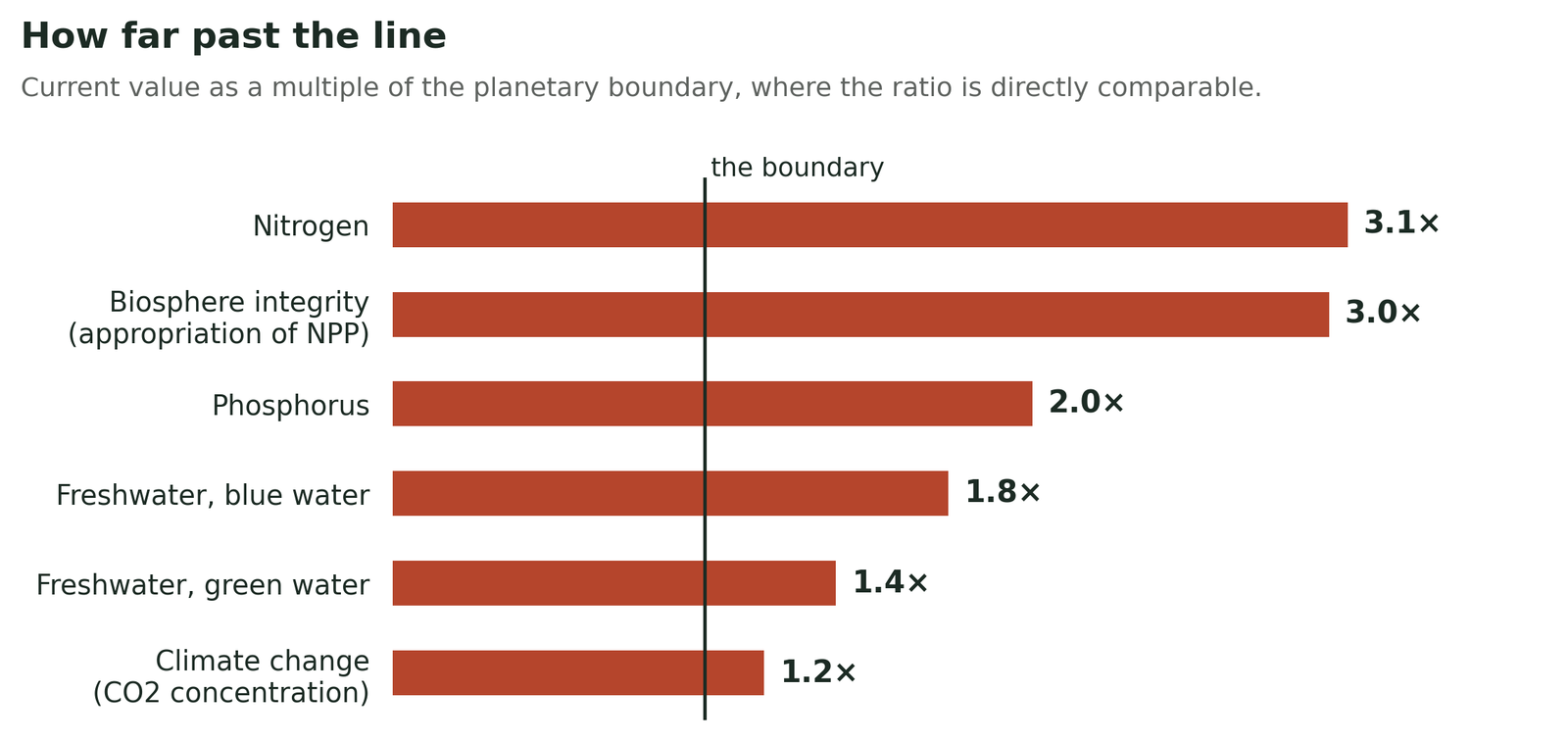
Look at the top of that chart rather than the bottom. Climate change, the boundary that occupies almost all of the public conversation, is the least exceeded of the six. Nitrogen, which is to say fertiliser, is running at over three times its limit, and almost nobody outside the field can tell you that.
The Definition at District Level
For state planners, district collectors and the officers who actually allocate anything, the abstraction resolves into something quite concrete, and India is a good place to see it.
Roughly 78 per cent of the country’s available freshwater is diverted to agriculture. Only about 48 per cent of the gross cropped area is irrigated. Rice, wheat and sugarcane occupy about 40 per cent of that cropped area and consume more than 80 per cent of the irrigation water.
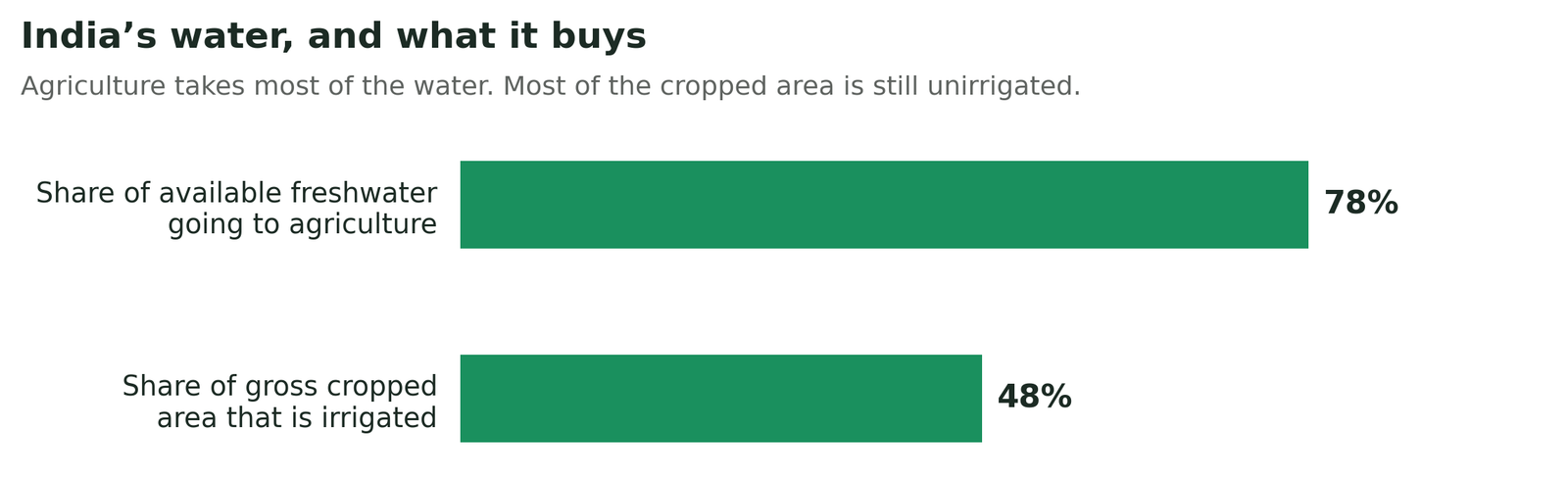
Every one of Brundtland’s three claims is visible in those numbers. Present needs are being met, for some people, in some districts. Future capacity is being drawn down, measurably, in aquifers that will not refill on a policy timescale. And the question of whose needs is settled every day by power tariffs and procurement prices rather than by anything resembling a deliberate answer.
The definition did not fail. It was never asked the question that actually has to be answered, which is not what sustainability means but who decides, at what scale, with what evidence.
Conclusion: A Question for the Present
There is a case that Brundtland’s vagueness was the point. A sentence precise enough to be operational in 1987 would have been rejected by half the countries that adopted it, and there would have been no Rio, no Agenda 21, and no common vocabulary at all. The imprecision bought the agreement, and the agreement bought forty years of work.
But the bill for that bargain is now due, and it is being paid at state and district level rather than at the United Nations. The numbers exist. Six of nine boundaries have values attached. The social floor has twelve measurable dimensions. What is missing is not the definition. It is the room in which the people who decide, the people who build, the people who fund it and the people who live with the result sit down together in front of the same evidence.
Read that way, ‘the needs of the present’ is not a phrase about the future at all. It is a question about this afternoon, in a particular district, about a particular aquifer, and about who is in the room when it is answered.